Rain Blooms
Lattice.

Rain Blooms Lattice is a physical edition of five works accompanying the on-chain release of Rain Blooms on Art Blocks Studio. Each work is assigned a distinct cellular automaton algorithm developed as part of the step-by-step process toward the completed form of Rain Blooms. These algorithms run locally on a microcontroller embedded within an aluminum frame.

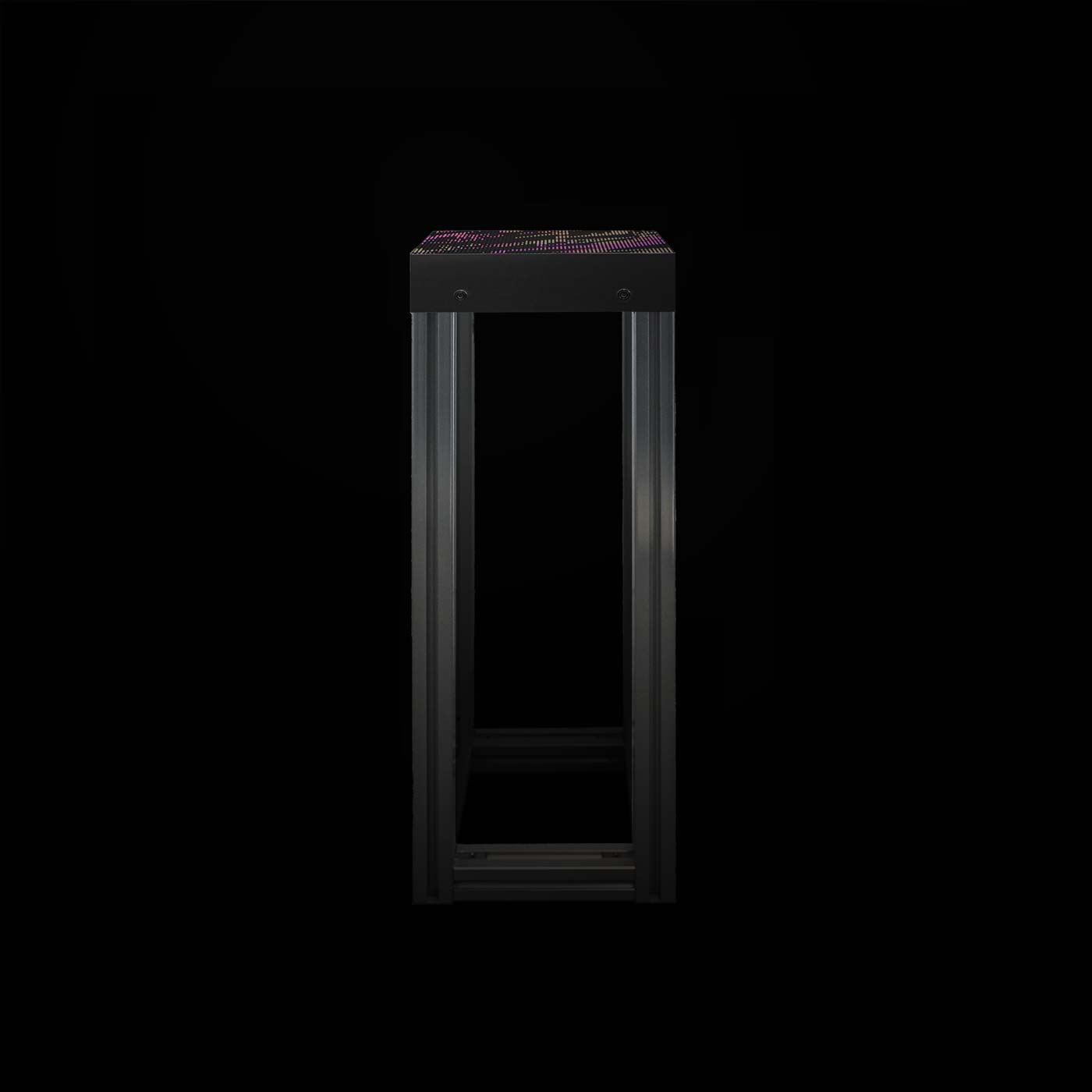
The LED matrix panel, mounted horizontally at the top of the frame, is intended to be viewed from above. The work does not display a recording. It computes its image continuously, frame after frame, for as long as it is powered on.

Artist
Kazuhiro Tanimoto
Edition
5 unique works
Medium
LED · Aluminum · Microcontroller
01 · Algorithm

A system that computes its own image.

Rain Blooms is built on an original cellular automaton — a computational system in which cells arranged on a grid are updated in parallel according to the states of neighboring cells. There is no central controller. What appears on screen is not shaped from above, but generated from the accumulation of local interactions.

This cellular automaton extends the classical model in several directions: neighbor cells are not limited to immediate surroundings, but can be chosen randomly or according to a pattern; multiple species are defined with relations of attack, assimilation, and indifference; and each cell carries a vitality parameter that affects the outcome of conflict.

The five works of Rain Blooms Lattice are each assigned a distinct cellular automaton algorithm that developed progressively during the step-by-step process toward the completed form of Rain Blooms.

Type2D multivalued cellular automaton
NeighborhoodExtended, non-fixed — chosen randomly or by pattern at initialization
SpeciesMultiple — relations of attack, assimilation, indifference
VitalityPer-cell parameter — increases or decreases through behavior, affects conflict outcomes
UpdateSynchronous, deterministic — identical parameters produce identical evolutions
ScaleKilobytes of code — portable to microcontroller, no external dependencies

"What I designed is not a final image, but a small system of local rules. Sound and image change together, in real time, from the interactions of those rules — not from a result decided in advance."

— Kazuhiro Tanimoto
FIG. 1
Moore
Von Neumann
Random
Extended

Examples of neighborhood configurations. The central cell (crimson) is updated according to the states of surrounding cells (black). Beyond the classical Moore and von Neumann shapes, Rain Blooms admits randomly chosen and extended neighborhoods.

FIG. 2
t = 0
t = 1
t = 2
t = 3

Iterated evolution of a simple cellular rule from a single seeded cell. Even at this small scale, structure that was not specified in the initial condition emerges through repetition of one local rule.

Lattice #1
Lattice

Five editions,
five algorithms.

Lattice #1
192 mm ¥220,000

A small number of monochromatic cells are placed on a 64×64 grid and treated as a single species. Color propagates to randomly assigned neighbors set at initialization — the foundational model for all that follows.

Lattice #2
384 mm ¥330,000

Hue is extended to two colors, each treated as a distinct species. Each cell is assigned a vitality value; competition between neighboring cells determines a winner, and the winning color takes the position.

Lattice #3
384 mm ¥330,000

Three to five hues are treated as multiple species and seeded in rectangular regions. Interaction occurs only when the hue difference is large enough — collisions, fragmentation, and sharp boundary formation become the dominant behavior.

Lattice #4
576 mm ¥440,000

Hue, saturation, and lightness are incorporated into the conflict outcome, making the result depend on the relationship between colors. Colors too far apart ignore each other; only cells within a certain hue range compete, producing more complex territorial dynamics.

Lattice #5
576 mm ¥440,000

Assimilation is added alongside competition — species gradually blend under certain conditions. Colors too close or too far apart do not interact; within a certain hue range, competition and blending coexist in the same space.

Rain Blooms Lattice — aluminum frame & LED panel
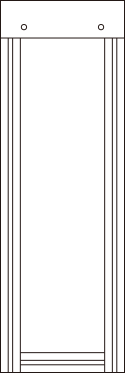
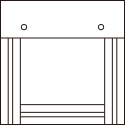
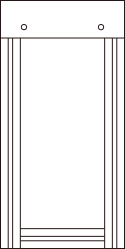
Aluminum frame · floor-standing · three heights
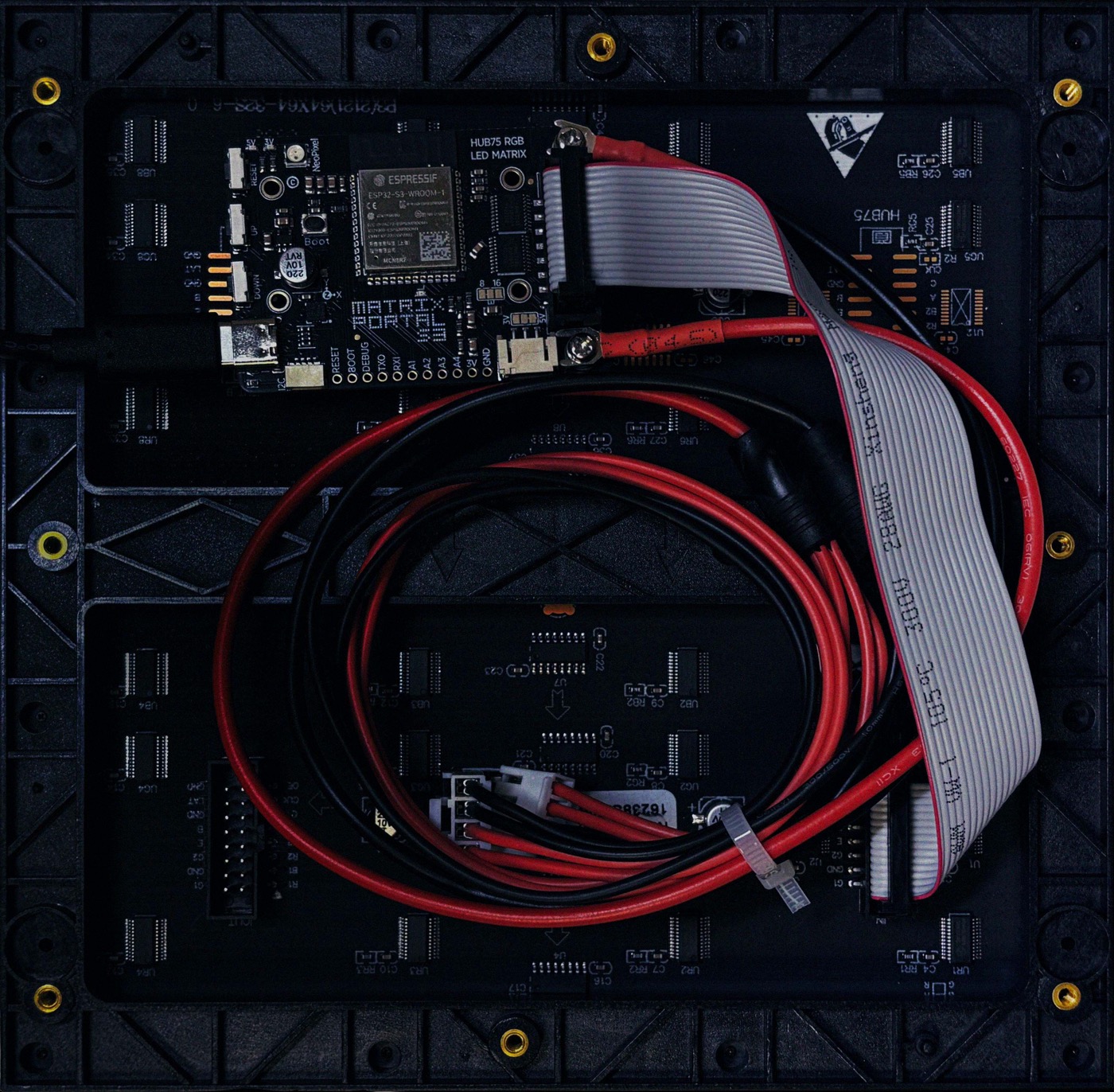
Rain Blooms Lattice — back panel
Interior · microcontroller & LED driver board
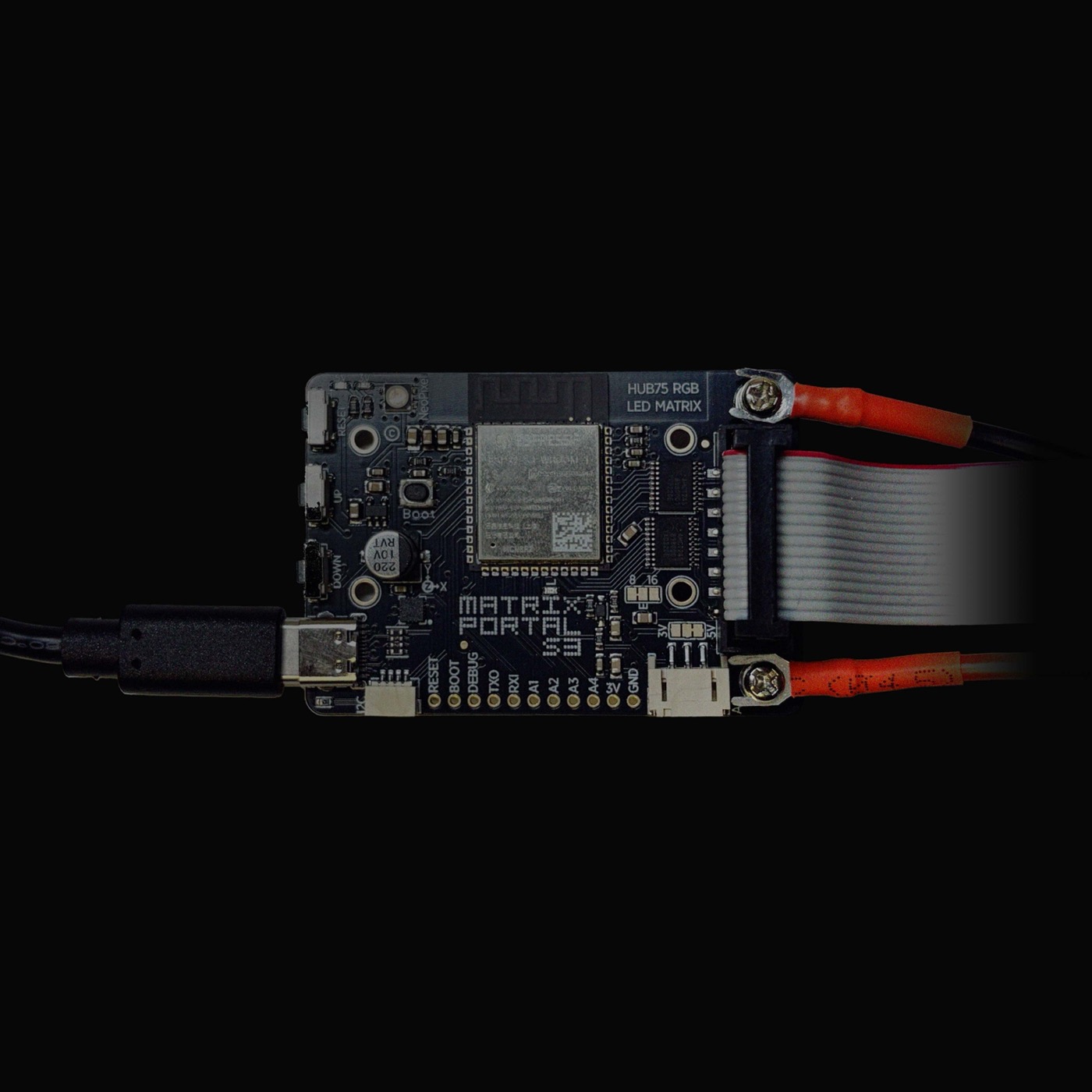
Rain Blooms Lattice — microcontroller
System diagram · standalone, no external dependencies
02 · Construction

Aluminum frame,
LED panel.

The housing is fabricated from aluminum extrusion — a material chosen for its structural precision and its neutral, industrial character. The frame makes no claim about the work's content; it holds the computation without ornamentation.

The LED panel is mounted at the top of the frame. The panel and the microcontroller board inside the housing together form a closed system — no external display device, no projector, no computer. The work runs entirely within the object.

FrameAluminum extrusion profile
Panel mountTop-surface horizontal mount
Power5V DC via standard power supply (included)
InstallationFloor-standing, no wall fixings required
FinishRaw aluminum / matte black
Panel192 × 192 mm
Height192 / 384 / 576 mm (three variants)
03 · Interior

Code on a circuit.

Inside the aluminum frame sits a microcontroller board running the Rain Blooms algorithm natively. This is the same algorithm that drives the on-chain digital edition on Art Blocks Studio — but here it runs on dedicated hardware, without a browser, without a network, without any external dependency.

The board communicates directly with the LED matrix through a ribbon connector. At startup, the algorithm reads its parameter configuration and begins computing. Each frame is rendered in real time — there is no video file, no pre-rendered sequence, no storage medium that the work plays back from.

Code on a circuit vs. code on a chain

The digital edition (Art Blocks Studio) is a license to compute: the algorithm runs whenever the token owner opens their browser. Rain Blooms Lattice is a machine: it runs whenever it is powered on. Same code. Different material conditions.

ComputeMicrocontroller (embedded, dedicated)
Execution formatArduino/C++ firmware
NetworkNone required
StorageAlgorithm embedded in firmware
OutputDirect LED matrix drive
04 · System

Standalone.
Self-contained.

Rain Blooms Lattice is a closed system. Once powered on, the work requires no network connection, no companion device, and no ongoing maintenance. The algorithm runs on the embedded microcontroller and renders directly to the LED matrix.

Because the work computes its image from local rules at the pixel level, each new startup under the same display configuration will produce the same evolution — identical parameters, identical behavior. The work is not random; it is deterministic from a fixed initial condition.
StartupPowers on automatically · begins computing immediately
DependenciesNone — fully self-contained
DisplayLED matrix (HUB75)
RefreshReal-time computation, frame-by-frame
DeterminismIdentical startup → identical evolution
PaymentBank transfer · ETH · USDC
ShippingFree within Japan · international at collector's expense
LicenseCC BY-NC 4.0
05 · Pricing

Three heights,
five works.

Each work is individually numbered (#1–#5) and unique in its parameter configuration. The panel size is fixed; the frame height comes in three options — 1×, 2×, or 3× the panel dimension.

1× height
height
¥220,000
2× height
height
¥330,000
3× height
height
¥440,000

USD/JPY ≈ 156.7 at time of writing

Size JPY USD (approx.)
1× height
¥220,000
approx. US$1,400
US$1,400
2× height
¥330,000
approx. US$2,100
US$2,100
3× height
¥440,000
approx. US$2,800
US$2,800
Digital Edition — Sold Out

The on-chain digital edition of 128 unique works on Art Blocks Studio is fully minted. Rain Blooms Lattice, the physical edition of 5 works, remains available for private acquisition.

06 · Collector

What comes
with the work.

Each physical edition is accompanied by a documentation package developed in accordance with the Matters in Media Art (MIMA) protocol — the conservation standard jointly authored by MoMA, SFMOMA, and Tate for time-based media art. The package addresses acquisition, documentation, loan, and long-term preservation.

Rain Blooms Lattice is a software-based work. Its identity resides in the algorithm, not the hardware. The documentation establishes which properties are work-defining and which may be adapted in future conservation without loss of authenticity.

01
The Work
Aluminum frame, LED matrix panel, and embedded microcontroller. All components are tested and verified prior to delivery. Available in three panel dimensions: 192 mm, 384 mm, 576 mm.
02
Certificate of Authenticity
Signed by Kazuhiro Tanimoto. Records edition number (#1–#5), panel dimensions, firmware version, Art Blocks Studio token reference, and date of production.
03
Identity Document
An artist-authored statement defining the work's essential properties. Specifies what constitutes the work's identity — the algorithm and its parameter configuration — and clarifies which aspects (hardware, display technology) may be substituted in future conservation without compromising authenticity, following MIMA Identity Report conventions.
04
Installation Instructions
Complete setup guide: orientation (horizontal panel, viewed from above), power specification (5 V DC), cabling, recommended ambient conditions, and safe handling notes.
05
Source Code Archive
The complete firmware source code stored on archival media. Serves as the definitive reference artifact for future conservation, migration, or re-implementation should the original hardware become obsolete.
06
Copyright License
Grants the collector rights to display, loan, and make preservation copies of the work. Consistent with MIMA acquisition standards for time-based media art, including rights for hardware migration and equivalent-specification replacement.
07
Conservation Notes
Guidance on hardware longevity, component replacement policy, recommended inspection intervals, and technical support contact. Includes the artist's explicit position on future substitution of LED panel and microcontroller with equivalent-specification components.
07 · Enquiry

Available
to collectors.

Rain Blooms Lattice is a private-sale edition of five physical works. Enquiries are handled individually through NEORT++.

Send enquiry
Enquiries via
NEORT++ · two.neort.io
Venue
NEORT++ · maruka 3F, 2-2-14 Nihonbashi-Bakurocho, Chuo-ku, Tokyo
Dates
15 May (Fri) – 31 May (Sun) 2026
Hours
14:00 – 19:00 JST
Closed Mon, Tue & national holidays · Free admission
Artist
Kazuhiro Tanimoto · kazuhirotanimoto.com
Platform
Art Blocks Studio · artblocks.io